
The following list is excerpted from Steve Crawford’s new book “1,000 Essential Songs from the 1970s.” While these tracks may not all be rare to serious music fans, none of these songs cracked the Top 100 on Billboard’s pop chart. The book can be found here . The format for these listings includes the songwriter(s) after the performer’s name.
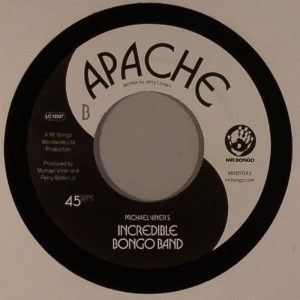
- Apache, Incredible Bongo Band (Jerry Lordan): The instrumental “Apache” was a #1 U.K. hit in 1960 for The Shadows, Cliff Richard’s backup band, and remains a staple today for high school marching bands. The Incredible Bongo Band was a loose affiliation of musicians that producer Michael Viner would use whenever MGM recording studios had no scheduled sessions. Their organ/percussion heavy version of “Apache” wasn’t a hit, but was latter dubbed “the national anthem of hip hop” and has been sampled by Missy Elliot, LL Cool J, Moby, Nas, and Grandmaster Flash. Drummer Jim Gordon, who had played with Derek and the Dominoes, was responsible for what would become one of rap music’s most famous beats.
- Bra, Cymande (Patrick Patterson, Steve Scipio): Cymande was a ten-man English funk band that reached #20 on the U.S. R&B charts in 1972 with “The Message,” a request for unity that has no lineage to the Grandmaster Flash rap. Specializing in a light, jazzy funk vibe that wouldn’t have sounded out of place next to War on your ‘70’s AM pop dial, Cymande mixed calypso, African influences, and what was then contemporary soul for this uplifting, percussion heavy track. De La Soul sampled “Bra” on their 1989 critically acclaimed 3 Feet High and Rising album.
- Chameleon, Herbie Hancock (Herbie Hancock, Paul Jackson, Harvey Mason, Bennie Maupin): Herbie Hancock established himself as an important figure in jazz in the 1960s, writing “Watermelon Man,” “Cantaloupe Island,” and working with Miles Davis. Hancock decided to put some funk into his music in 1973 and the Headhunters album was a jazz/funk fusion unlike anything ever released. The music comes at you in waves; the five musicians are credited with playing 22 different instruments on the album. “Chameleon” has been covered by Maceo Parker, Buddy Rich, Gov’t Mule, The String Cheese Incident, and countless small jazz ensembles.
- Goin’ Down, Freddie King (Don Nix): Freddie King was a Chicago, by way of Texas, bluesman who found himself on the pop charts in 1961 with the instrumental “Hide Away,” a #29 pop hit later covered by John Mayall’s Blues Breakers when Eric Clapton was in that band. In the early 1970s, King made a series of albums with production and writing assistance from Leon Russell and Don Nix. “Goin’ Down,” from the 1971 album Getting Ready, is freight train blues power with Russell pumping out fast paced piano notes while King tosses out his inimitable blues licks. Especially in Texas, King remains a major source of inspiration for young, blues based guitar players.
- Hey Pocky A-Way, The Wild Tchoupitoulas (Ziggy Modeliste, Arthur “Red” Neville, Leo Nocentelli, George Porter, Jr.): The concept of The Wild Tchoupitoulas was based on the Mardi Gras Indian tradition, a custom that goes back hundreds of years involving African Americans in New Orleans donning Native American clothing as part of the annual party festivities. Music was part of the tradition, often using call and response and chant structures. George Landry, also known as “Chief Jolly,” was asked to record an album of Mardi Gras Indian music and he was well connected with relatives in the Meters and nephews Charles and Aaron Neville. The Wild Tchoupitoulas album is a celebration of this culture and “Hey Pocky A-Way,” originally recorded by The Meters, put some greasy funk into the equation. This project resulted in the formation of The Neville Brothers in 1977.
- How Do You Spell Love, Bobby Patterson (Marshall Boxley, Jerry Strickland & B. Patterson): Dallas based soul man Bobby Patterson has worked as a musician, songwriter, producer, promotion man, disc jockey, and served as a mentor to upcoming artists including Jimmie Vaughan and his little brother, Stevie Ray. Not yet thirty years old, Patterson still sounded retro in 1972, more like a Stax shouter instead of a contemporary funk act, but his enthusiasm has never been less than infectious. Covered by The Fabulous Thunderbirds in 1982, the man knew how to spell love – M.O.N.E.Y.
- I’d Rather Be With You, Bootsy’s Rubber Band (Bootsy Collins, George Clinton, Gary “Mudbone” Cooper): Bootsy Collins was still part of the P-Funk Mothership in 1976, but released his first solo album that year, with production and songwriting assistance from George Clinton. “I’d Rather Be With You” is a trippy, funk love song ending with one of Bootsy’s audacious stoned raps (“I’m gonna stick my love in your eye, baby”). A romantic ballad with stoner pupils.
- If We’re Not Back in Love by Monday, Millie Jackson (Sonny Throckmorton, Glenn Martin): “If We’re Not Back in Love by Monday” was a hit on both the country and R&B charts in 1977. Merle Haggard took his reading to #2 on the country charts and Millie Jackson had a #5 R&B hit. The song is about a couple on the rocks that propose spending one more weekend together to determine whether they should stay together. Millie’s version has a quiet storm, jazz infused quality with vocals reminiscent of Gladys Knight’s soul ballad style.
- It’s Just Begun, The Jimmy Castor Bunch (The Jimmy Castor Bunch, Johnnie Pruitt, Gerry Thomas): Jimmy Castor was a music business veteran who started recording in the mid-1950s, but didn’t score a major hit until 1972’s “Troglodyte (Cave Man),” a #6 pop single. The title track of his breakthrough album, “It’s Just Begun” is a high energy, horn driven James Brown-meets-“Psychedelic Shack” number that incorporates fuzztone guitar and has an often sampled percussion break. The Jimmy Castor Bunch returned to the pop charts in 1975 with “The Bertha Butt Boogie,” a novelty funk number that is sadly almost impossible to erase from your memory’s hard drive.
- Jingo, Candido (Babatunde Olatunji): Nigerian percussionist Babatunde Olatunji first recorded “Jin-go-lo-ba” as a rhythmic chant in 1959 for his Drums of Passion album. Similar to how rappers would later sample music, Carlos Santana took the drum beats from Olatunji’s composition and transformed them into the Latin rock world for “Jingo” on the 1969 Santana album. Cuban born percussionist Candido Camero moved to the U.S. in 1952 and worked as a sideman for jazz greats Dizzy Gillespie, Art Blakey, and Sonny Rollins. Candido moved into the world of dance music with his 1979 album Dancin’ and Prancin,’ a record best known for a nine plus minute polyrhythmic conga and bongo disco/funk/jazz dance number take on “Jingo.” DJ Fatboy Slim updated “Jingo” into the world of electronic dance music on his 2004 album Palookaville.
- Love and Happiness, Al Green (Al Green, Teenie Hodges): “Love and Happiness” was never a hit single, but it is one of Al Green’s most hard hitting performances. Green, “The result was like a slow fever…like mixing raw chemicals.” A complete tour de force from the rhythm section, the call and response gospel backing vocals, the funky Hammond organ sound, and the punchy, staccato horns. Listen closely to the intro and you can hear guitarist Teenie Hodges count off the beat on a cardboard box. Pure Southern grits soul.
- Mos’ Scocious, Dr. John (Mac Rebennack): Proponents of New Orleans based music consider 1974’s Desitively Bonnaroo not only one of Dr. John’s finest albums, but one of the best pieces of work by The Meters, as well. “Mos’ Scocious” isn’t a traditional Cajun term, but one invented by Dr. John and interpretations vary from “everything’s fine” to “the best of the best.” What we do know is that the song is sexy Latin-tinged New Orleans R&B with salacious intent and a bit of blooze blur in the groove. How’s this for a direct opening line? “I really want to do you up so bad!”
- Move on Up, Curtis Mayfield (Curtis Mayfield): As the leader of the Impressions, Curtis Mayfield had often written lyrics with political, social, and spiritual themes. “Move on Up” works as a song of encouragement, a push to improve social standing through industriousness, and as a spiritual message, with a goal of moving up to the promised land. Musically, a stunner. Upbeat horns weave in and out with orchestration, the percussion section is relentless. This is jazz, pop, soul, and funk brilliantly mixed together to transport the listener to a higher dimension.
- A Nickel and a Nail, O.V. Wright (Vernon Morrison, D. Malone): Overton Vertis “O.V.” Wright hit the R&B charts seventeen times between 1965 and 1978, but never scored a pop hit. “A Nickel and a Nail” is a blues blaster, recorded at Hi Records in Memphis with Willie Mitchell, a studio known for the smooth sounds of Al Green. Wright brought a deep soul gospel voice to this plaint about a woman who took his love and his money, leaving him with nothing. With support from the Memphis Horns, this is a soul shouter that is both retro and timeless.
- The Revolution Will Not Be Televised, Gil Scott-Heron (Gil Scott-Heron): The 1970’s premier pre-rap rapper made his first major commentary, after publishing two books, with this withering criticism of American media culture and especially its impact on the African-American community. The central concept, that Americans would rather be distracted by mass media than address their own issues, still remains despairingly relevant. Scott-Heron’s anti-sloganeering sloganeering is supported with positively righteous smooth jazz funk. He was also paying respects to his elders in a way, extending the concept described in “When the Revolution Comes” by The Last Poets.
- Strawberry Letter 23, Shuggie Otis (Shuggie Otis): The son of the rhythm and blues bandleader who gave the world “Willie and Hand Jive,” Shuggie Otis started recording at the age of fifteen and released three albums during the 1970s that were a quiet storm concoction of blues, rock, funk, and pop. This trippy slice of psychedelic pop is better known from the 1977 hit cover version by The Brothers Johnson, but I prefer the cool acid vibe of the original.
- Think (About It), Lyn Collins (James Brown): Abilene, Texas native Lyn Collins released her first recording at the age of fourteen and joined the James Brown Revue in the early 1970s. Billed as “The Female Preacher,” Collins counsels men to treat their women right on “Think (About It),” a track produced by James Brown with backing instrumentation from the J.B.’s. Not a hit record in its day, this has become one of the most sampled James Brown numbers – most famously, the 1998 hip hop classic “It Takes Two” by Rob Base and DJ E-Z Rock took its lyrical hook and beat from this song.
- Uptown Top Ranking, Althea & Donna (Althea Forrest, Donna Reid, Errol Thompson): Virtually unknown in the U.S., the reggae number “Uptown Top Ranking” hit #1 on the U.K. pop charts in February of 1978. The structure of the song had originated with Alton Ellis’s “I’m Still in Love” in 1967 and was used again for Marcia Aitken’s “I’m Still in Love With You” in 1977. With Jamaican rhythm section legends Sly Dunbar and Robert Shakespeare providing the groove, Althea & Donna demonstrated some pre-hip hop swagger, singing about styling in a Benz and causing heart attacks with their skimpy clothing. After becoming the youngest female duo to score a #1 hit in the U.K., they never touched the charts again.
- When Did You Stop Loving Me, When Did I Stop Loving You, Marvin Gaye (Marvin Gaye): Based upon his divorce settlement, Marvin Gaye was required to give fifty percent of the royalties from his 1978 album to his former wife and the elder sister of Motown founder Berry Gordy, Anna Gordy Gaye. Marvin did little to hide his legal predicament from the public, titling the record Here, My Dear. He also perhaps made it less attractive to the buying public by releasing a double album with no potential singles. “When Did You Stop Loving Me, When Did I Stop Loving You” is a six minute long, jazz based peek behind his marital curtain filled with recriminations and disappointment. Disturbing and fascinating.
- Yes We Can – Part 1, Lee Dorsey (Allen Touissant): Lee Dorsey scored Top Ten pop hits in the 1960s with “Ya Ya” and “Working in the Coal Mine.” When he wasn’t climbing the pop charts, he worked at his own auto repair shop in New Orleans’ 9thWard. Dorsey had the good fortune to record with The Meters, who gave this brotherhood anthem “Yes We Can” a potent funk treatment. While not a hit for Dorsey, “Yes We Can” had a few more lives in it – it went to #11 on the Top 40 for the Pointer Sisters in 1973 (as “Yes We Can Can”) and also became the unofficial New Orleans anthem for post Hurricane Katrina reconstruction in the mid-2000s.
