
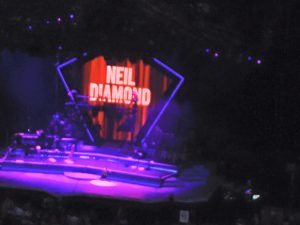
“If I close my eyes, I can almost hear my mother tell me go find your brother…”
I don’t think the past has to be happy or sad for people to feel the tug of nostalgia, I think it having happened to you is more or less enough…. sometimes it’s enough for it to have happened to somebody else. For Neil Diamond, 74 years old at Barclay Center Thursday night, and back on the “Brooklyn Roads” of his youth, it is his nostalgia and not ours we are listening to. And for such a sentimental and schmaltzy man, he underplays the tug of nostalgia as best he can. Looking slim, but old, he is 74, his titanic (oddly swarthy for a member of the tribe) masculinity (dare I say sexuality) of Hot August Nights period Diamond well behind him, so far behind him, Neil doesn’t even kneel to hug his female hausfraus in the front row, what is left is his past in this present, yet there was no sense in which Diamond used Thursday nights return to the street to return to the street in Brooklyn of the 1950s. The self-awareness of his past didn’t lead him to any form of self-revelation on stage Thursday night and yet, the nostalgia was sometimes shared.
Sure, “I Am… I Said”’s “New York’s home…” received a round of applause but it does at MSG as well, it’s just home field advantage. and otherwise… we didn’t even get his childhood song “Shilo”. What we did get is “Brooklyn Roads” and, again, my feeling is this is hardly the first time he has used his past on stage. Not the first time he has shown this grainy old film of a boy Diamond and his brother, even his mother, in 8mm home movies filmed by his dad, revisiting his childhood, where the cheerful, good looking kid was enormous in his ordinariness, and all the while Neil sings his “Recherchez de Temps Perdu” –a masterpiece of nostalgia and childhood, filled with the sounds and smells of his childhood just outside the doors of the Barclay Arena though 60 odd years in the past, so you feel you could open the doors and step back in time and go in search of him. His nostalgia and ours for his past history.
“Brooklyn Roads” is off the not particulalrly good 1968 Velvet Gloves And Spit, (though it was re-released in 1970 with the terrific “Shilo” added), his third album, and Diamond must have been in his mid-20s when he wrote it. Old enough to look back but still young enough to be unaware of just how far away he would end up one day. His father died in 1985 and what was a reverie of childhood (not always happy; a young Neil scared to show his report card is an indelible image in the song) becomes a lost world never to return. Singing it, remembering it, Thursday night, everything promised, and everything Barbra Streisand insisted upon doing during her return to Brooklyn two years ago, comes to fruitation: you can see , here, feel, the place so near him, so close to the touch of him: his first Brooklyn concert. He couldn’t come close to imagining this future there, here at home.
But if this tug seems real for a moment, the rest of the night is a typical Neil Diamond, the singer-songwriter who worked his way out of the Brill Building (“he was very shy”, Donald Fagen recently recalled) through years on Bang Master as a one man hit machine and finally, making schlocky, operatic pop culture songs. From there he morphed to MOR leading man and finally the hits stopped coming and while he kept recording, at Barclay’s he chose three excellent cuts off his frankly lousy last two albums, and raked in the money by touring.
Diamond has been at this since 1962, when he released his first recording, but his mastery began in earnest in the Brill Building where he wrote “I’m A Believer”,”A Little Bit Me (A Little Bit You)” and Look Out (Here Comes Tomorrow)”-all hits for the Monkees, as well as “The Boat That I Row”, “Solitary Man”, “Girl You’ll Be A Woman Soon”” and more, before joining Bert Berns Bang Records and adding the likes of “Cherry Cherry” “Kentucky Woman”, “Thank God For The Night Time” and many more. Then he signed to MCA and from 1968 – 1972 he was good for a coupla songs on overblown albums and, then, presaging Frampton Comes Alive, put them altogether on the live double Hot August Night, an album I worshipped as a fourteen year old but am much less impressed with today. .
Ever since then, Neil has been your Grandma’s fave and disappeared into overblown pop schlock. August? Sometimes. Hot? Not so much.
At Barclay Center on Thursday, he wasn’t even all that schlocky either. I don’t wanna say he was withdrawn quite, but there was a certain level of reticence in his performance, an unwillingness to quite join the party. Telling us to dance before “Red Red Wine”, his heart wasn’t in it, and introducing the overblown ballad “Play Me” he took a cheap shot at his age, and kinda derailed the moment. With two back up singers, a horn section, guitarist, bassist, synth player, drums, tom toms, and keyboards, even himself on unnecessary acoustic guitar, the band still didn’t sound all that full. As a septuagenarian, Diamond has a cooler hand than we are used to him showing, while in his element, he allows himself the privilege of letting the songs do some of the heavy lifting for him. From a an opening “I’m A Believer” through a fistful of Bang Record songs, to a mini-August night to end the set proper, a couple of cracklin’ singalongs for the encore and the execrable “America” (I left half way through it), he crowd pleased to a great degree without being remotely the thirty year old sex symbol of yore.
The band were pretty good, the keyboard was a particular pleasure and so was the tom tom player. There is no problem with Neil and presence (charm? Not so much). The songs were brought out again and to his credit, Neil gave the same intensity to every song (he doesn’t perform a medley ever, even when that means missing a ton of hits -not only don’t we get “If You Know What I Mean”, unbelievably enough we don’t get “Song Sung Blue”… and don’t miss either till afterwards). What Diamond is is a great songwriter who through a fluke of timing and chops and chance became a master singer-songwriter, but there is a laziness to a craft that has managed to sell over 125 million songs worldwide in 50 years. For every well perfect, “I am I cried, I am said I” there is a million “Pour me a drink, and I’ll tell you some lies”. For every “Brooklyn Roads” there are mountains of “Hello Again”. What he does, where he will be remembered, are huge singalongs like “Sweet Caroline” and “Song Sung Blues” –immensely sticky tunes for children of all ages.
This is great pop without being great art. With exceptions, Diamond is insignificant. He is a craftsman as certain as, say, Dr. Luke is a craftsman in 2015. He is, again, a songwriter, a Brill Building graduate, who is not good at revealing himself. “We write songs to tell the truth” Diamond claimed before the gormless “The Art Of Love”, but he doesn’t tell any truth, and he didn’t at his big homecoming. In the end, Diamond neither could nor wanted to come to terms with either Brooklyn or his childhood. You wouldn’t expect it of, say Holland-Dozier-Holland, why expect it of Diamond even if that is what he is selling in a very specific way is precisely that? Revelations. By the time Diamond hit the 1970s, he’d stopped being a great pop songwriter and had become a popular MOR popstar. The most typical Diamond song is “You Don’t Bring Me Flowers” (which he didn’t play this night –though Streisand did when she performed at Barclays). Co-written with Alan Bergman and Marilyn Bergman, the most professional and redoubtable of songwriters (they were behind “LA Is My Lady” among many, many other bad songs) and produced by one man hit making machine Bob Gaudio, the modern equivalent would be “Fourfiveseconds” –a collaborative effort made to chart. You may admire the business acumen, but the song itself?
All of this found Diamond trying to regain some form of credibility and reaching out to Rick Rubin, who couldn’t do it, and on his latest, tracing his style of pop songs, and again (though “Something Better” sounds much better after hearing it live) failing to do so (as an aside, let’s give kudos to McCartney who found a way to insist upon his credibility as a pop musician at the age of 70 on, at least, “All Day”).
Finally, Neil comes back home and somehow or the other, there is nothing left to connect in Brooklyn just words, the feelings seem to be missing, he can’t quite get there. Except for “Brooklyn Roads’”…
“If I close my eyes, I can almost hear my mother calling…”
Grade: B
