
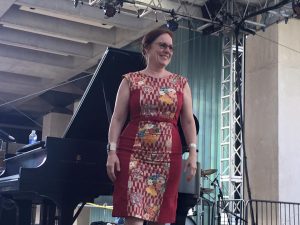
There are hooks and then there are hooks, and the catchiest one at Iris DeMent’s one hour set as part of Lincoln Center’s annual Americana Festivalm “as if farther is not grave of ours”, is off her new album. The lyric is based upon a translation of a poem by the late Russian Anna Akhmatova, a woman who lived through Russia’s tumultuous years from World War One and the Russian Civil War through the Stalin and Kruschev regimes,till dying in 1966. In all those years, “Akhmatova’s first husband, Nikolai Gumilev was executed by the Soviet secret police, and her son Lev Gumilev and her common-law husband Nikolay Punin spent many years in the Gulag, where Punin died”. Anna herself was considered an enemy of the State – sort of Dr. Zhivago if Dr. Zhivago was Emily Bronte.
For the penultimate performance of Lincoln Center’s annual Americana Festival, we got Iris DeMent on piano, with a small band, steel guitar, bass and drums, distilling the essence of environmental charm as they dipped into the Arkansas singer songwriter’s catalog and new album with a drawl so thick I still wouldn’t know what she’s singing about if I didn’t know already, in an all too brief 65 minute set. Yes, environmental: what Anna, Emily and Iris have in common is that they are a product of their place, Anna is as Russian as Pushkin, and though now living in Iowa, Iris is steeped in Arkansas, not quite hayseed, not the sense you might think, but an otherness deep, as deep as a woman who compared the words of the Russian poet’s “On An Airplane” to a Johnny Cash lyric and made it stick, can be.
Did you notice the “all too brief” mention there? Way, way too brief. When I last saw Iris, at City winery (here), I was complaining that the concert was too long and Iris seemed a little jittery, nervous maybe? It was something of a grand return and now two years later with her second album of new material in three years and also her second album of new material in sixteen years, she isn’t jittery any more. She is not so much calm as deeply concentrated, her light hearted banter (giving away the albums she hasn’t sold to make room for new shoes, Iris cracks and there is a line to get hold of it the second the concert is over) doesn’t change the change in vibes when she begins to play. That lack of jitters, that sort of extremely assured performance, has everybodies rapt attention. Or nearly everybody, towards the back of the audience on the lovely summer Sunday afternoon, children are playing, with the deeply felt but somewhat ambient songs fluttering somewhere behind them.
It is very a moving and in a sense a very appropriate juxtapositioning, the songs themselves, mostly from her new album The Trackless Woods, transpose the words of the poet to the sounds of the American heartland, and they have a domestic feel to them, Iris wrote them in the living room of her Iowa home and recorded them the same place. As she told Ann Powers on NPR.com: “I couldn’t imagine recording this record anywhere other than my living room. I tried to talk myself out of that for many reasons. One being it was quite expensive to convert my home in the middle of Iowa into a studio …. It meant flying in musicians, an engineer and a fair amount of equipment and then of course all of the complications that go with recording in a uncontrolled environment with dogs, cats, garbage trucks and delivery people knocking on the door. It made no logical sense, and yet, I don’t know that I could have sung them the way I did anywhere else. Besides, my meeting with Anna took place in that setting, most these songs were written at the same piano I recorded them on. I felt like Anna was there and I didn’t want to leave her behind. I don’t think she’d have been comfortable in a studio. And neither would I. Plus, I think pianos are happiest when in close proximity to a kitchen. Music and food just go together.” And that is why families and friends coming together with their children, dogs barking in the background, old friends searching out seats in the shade, those who couldn’t have gotten into a City Winery, is a superior meeting of worlds.
Iris gave her songs a stately and graceful mid-tempo performance and while the tone and tempo was more or less constant, when she did let loose, a rousing “Livin’ On The Inside” near the homestretch, sounded subtly subversive, it was like a cool breeze, it shook us up and was all the better for it, Iris got as close to getting her Jerry Lee on as she ever shall, the lead guitarist played great little licks and the drummer got more than the flutter we were used to. As for the voice, I know “Livin’ On The Inside” well and would still have had no idea what she is singing. It is an odd thing from an album built on words, to be indecipherable, but that’s what it is; Helen Bach watches “Eastenders” with the close caption on because she can’t understand it and I feel the same here. But it is a beautiful instrument Iris has, so full of love and soul and feeling, so intensely real, that I’ll forego comprehension for sound. It seems to have a fringe of sadness around it, it seems to move you closer to a deep and exulted connection to life.
Also, I had spent the week checking out Anna Akhmatova’s, I had never heard of her before, and while I love her words, it is strange to hear such sad strange and strong words in a musical setting, and it doesn’t entirely work on the album. The actual songs are missing Iris’ usual tunefulness, not always but often enough for the songs to miss your memory box, they sound wonderful and they sound real but they don’t sound like great songs (for obvious reasons, some of them have no chorus at all). Once you’ve written “The Night I Learnt Not To Pray” –about the childhood tragedy when her brother fell down the stairs and died, you don’t really gain as much as you might from Anna’s glorious words of disasters unresolved and a life well examined. Poems aren’t lyrics and it effects the song structure -especially when you are changing the language, from Russian to English, if only it was only from another Romantic language. When Nabakov translated Pushkin, he decided to do it literally, as a crib sheet with copious notes, because he didn’t believe it could actually be done.Certainly, hearing Anna’s voice on the last moments of the albums, the words have a rawness to their sound not found with Iris. Iris has a dry warmth, Anna a full toughness. Anna’s words were once put to music by Russian composer (and former lover) Arthur Lourié, by which I mean he composed music (dramatic strings cutting through your consciousness, in the one I heard here) while her words were read. It couldn’t be more early 20th Century if it wanted to: it has nothing, it is harsh and a little ugly: it seems to be fighting to be heard, where iris writes music to be deeply consoled by. Lourié is backing out and DeMent is backing in.
On The Trackless Road, DeMent arranges the words from poetry to lyric, sometimes, as on “The Broad Gold”, she does this by eschewing a chorus, and this time the effect is beautiful indeed. “Come here, sit closer in our nook, and turn gay eyes at what my nurses might never glimpse: the blue-bound book that holds my awkward childish verses” sounds like the closeted world of the Bronte sisters, it seems to be where poetry is the place and release in the specific place. The melody here is very strong, and the pace is like a lullabye that doesn’t. But by the next song, its stateliness drags it down a little and therein lies her problem, not consistency of words but a consistency of style and tempo which draws you out instead of in, it is a little tiresome.
It’s a problem that Iris manages to answer from time to time with resounding success. “Listening To Song” is not just the right poem for the right singer, the vision of how a voice can move you away from the grave and towards heaven on earth, is as great a song as Iris has ever written, too often I am at a loss as to the necessity or the connection between the two but this is very clear.
Still, how can Anna’s stoic presence in the face of ridiculous odds quite fit into 21st Century Americana? Anna’s persecution, after executions, wire tappings, a refusal to immigrate, condemnation from the State, didn’t end till Stalin’s death in 1953 when her poems began to be published to great acclaim and embraced by all sides. Her son Lev was released from the Gulag in 1956. Listen to “The Souls Of All My Dears” (“have flown to the stars”) to get a sense of have difficult Iris work is and how perfect and empathic she can be. For The Trackless Road it is wrong to say you can’t consider an album both flawed and a masterpiece, a beautiful, daring exploration of another person’s art that seeks a middle ground and doesn’t get there. An album that neither dodges nor weaves, that forces you to meet it more than half way. A friend of mine who is, like me, a huge Iris DeMent fan, told me it is the first of her albums to disappoint him. He wondered if, since it took sixteen years between her last two albums of new material, perhaps it was rushed. Good guess, but apparently Iris had been composing it before she began 2012’s masterful Sing The Delta. Then what? Sing The Delta is definitively a superior album but The Trackless Woods resonates stronger. It is an album that you might be confounded by, but you are confounded by it in the best way possible. It is like loving a woman with deep flaws better than an angel, the flaws define it, they trouble at you but you embrace its humanity. Peoples imperfections are, to quote Van Morrison, the love that loves to love.
Sunday afternoon, this isn’t quite what comes through, for all Iris’ attempts, it isn’t Anna’s story but a different one that emerges. New York brought its friends and families (and me) to enjoin with Iris and songs for Iris and her adopted daughter Dascha from St Petersburg. Iris and his husband, songwriter Greg Brown added to their family ten years ago when Dascha was six years old. At six years of age, your brain is developing at full speed, your sense of injustice, a leap from magical to logical thinking, is occurring, you are very aware of the world and you are beginning to realize how it functions, and to move from Russia to the States with a new family, must have had its own very clear additional brain fuses. Iris used Anna to teach her more of Russian culture so as she could understand her young daughter better. Then the album got away from Iris -her reasons for making it were essentially because she had to. At Hearst Plaza, it is the Familial that comes closest. The reason it worked better for me here than at City Winery was because the environment was conducive for songs about home and family and nature, -whether or not the songs were specifically happy, they were of a place and a way and time, compassionate and sharing.
Iris encored with “The Morning Glory” a nature song, and one that sent me back to my collected Emily Bronte poems and not to Anna:
“It was a little budding rose,
Round like a fairy globe,
And shyly did its leaves unclose
Hid in their mossy robe,
But sweet was the slight and spicy smell
It breathed from its heart invisible.”
The Moors of Yorkshire, the cold steel of Stalingrad, the dustiness of Arkansas, a parlor in Iowa, a family outing in New York City: Iris brought them altogether on one wonderful afternoon.
Grade: A
