
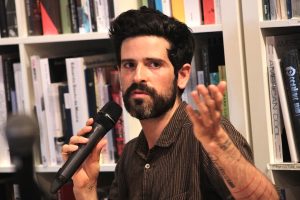
Maybe the LACMA museum hadn’t expected so many people for Devendra Banhart’s book signing? It was held in the Art Catalogues small room, and the line to get in seemed to be several miles long when I arrived in front of the museum. I was almost certain I would not able to get in, but they finally increased the capacity, with more chairs outside the room and a TV screen to follow the talk and performance.
Devendra Banhart is an eclectic and eccentric character in the music world, he is described as a multidimensional artist and he has released a few weeks ago, a book with a funny title, ‘I Left My Noodle on Ramen Street’, collecting his visual art. Art was the subject of the discussion, and beforehand he gave a brief performance, but since I hadn’t managed to find a place in the crowd yet, I couldn’t see anything and heard a little bit of his singing backed up by a full band, in an acoustic setting. I have to admit it, I haven’t really liked his recent albums, but there was a time I couldn’t get enough of his cute, touching and funny songs off his first albums, songs like ‘Little Yellow Spider’, ‘This Beard is For Siobhan’ or ‘At the Hop’,… How can’t anyone not like this one?
I regret I missed most of his very short performance but the subject of the day was his art book, which can be described as part artist’s monograph, part scrapbooked personal history. It gathers his work in chronological order, his very peculiar abstract figurative paintings, inspired by the works of Paul Klee and Cy Twombly, with his own commentaries, essays and conversations with a few of his famous friends, including Beck, Jeffrey Deitch, and ex-Moldy Peaches’ Adam Green.
During the conversation with 5 Every Day head-writer Zach Pennington, Devendra mentioned several times the term practice, to describe his art, ‘The work is serialist, it’s repetitive’, he said. ‘The only reason we keep making this work it’s because it is a practice’. He has been making art for his album covers since the beginning, as something accompanying his music-making process. For him both disciplines blend and merge, ‘One serves the other’, he said but ‘The work in this book is closer to the music I’d like to compose’ he admitted.
In term of functionality, he said that his art is Intended to be shared, and all done for someone, a group of people or a thing. For example there is a series watercolors representing monuments, and the first one was born when he was still in Venezuela, just after the death of INXS’s Michael Hutchence: ‘The guy from INXS has just died, I drew a monument, a scaffolding as a proof of my sorrow and at the top I put INXS. It was a way to express my sadness about losing this great pop star’. If there’s a devotional aspect to Devendra’s art, his function stays in the perpetual practice: ‘There’s no goal, it is a practice’ he repeated several times, ‘even if it is a homage’.
These days, Devendra has settled down in Los Angeles where he has set up a downtown painting studio. It’s a city that he sees as a series of little cosmopolitan villages connected by freeways, and he intends to equally divide his time between art and music, ‘It’s a delusion we are making a million things at once’, he said. ‘And it’s very useful to take a break from each discipline’
Although he has exactly the same practice-motivation approach for his two métiers, there are some differences, ‘Pop songs are fun to write, art is different, I would not say it’s fun’… ‘I would not say it’s not fun, but pop songs are fun!’
In any case, the funny title he picked for his art book proves he hasn’t lost his sense of humor. Plus looking at him talking so elegantly about art, and signing his book to the many people who had rushed to the cashier to buy it, I can be reassured, Devendra hasn’t lost any of his unique charisma.