
Dianna Theadora Kenny is fascinated by the relationship between musicians and death and who isn’t? She has already explored musicians and longevity, demonstrating that they generally die at a younger age than the rest of the US population. She also demolished the 27-club myth, showing that musicians were at a greater risk at the age 56!
Kenny says that other studies have reported similar reduced-life expectancy in musicians, as the median ages of death for musicians in this study were 41.78 and 45.2, which is awfully young. Only this past year, we lost Joe Cocker (70), Ian McLagan (69), Bobby Keys (70), Big Bank Hank (57), Wayne Static (48), Jack Bruce (71), Tyson Stevens (29), Joanne Borgella (32), Isaiah Owens (39). Mark Bell (43), Robert Throb Young (49), Simone Battle (25), Michael Johns (35), Dick Wagner (71), Tommy Ramone (65), Bobby Womack (70), DJ E-Z Rock (46), DJ Rashad (34), Shane Gibson (35), Jesse Winchester (69), Big Glo (33), Jason McCash (38), Frankie Knuckels (59), Tim Wilson (52), Paco de Lucia (66), Bob Casale (61), Dennis Frederiksen (62), Phil Everly (74), Jack Bruce (71), Johnny Winter (70), Rick Rosas (65), Doc Neeson (67), Ed Gagliardi (62), Gary Burger (72), Gerry Goffin (75), Jake Hooker (61), Jay Traynor (69), Jesse Winchester (69), Billy Rath (66), Alvin Stardust (72), Wayne Static (48), Jonathan Athon (32), Clive Beer-Jones (65),…the list can go on and I just picked a few of them, but they all seem too young to die considering the US life expectancy in 2012 was 78.8 years! The only exceptions being Franny Beecher and Pete Seeger, who died respectively at the old ages of 92 and 94! The average age of death of this list is 56.6 without the last two, and 58.3 when they are included, and despite the fact that this quick survey is far from being an extensive study, this shows that, this year too, musicians died very young and the numbers verify the studies.
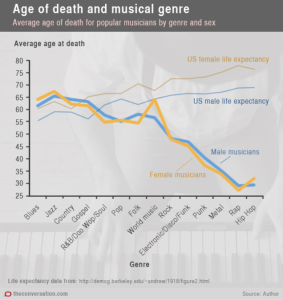
In a new article, Dianna Theadora Kenny decided to go further and to investigate whether different music genres affect musicians’ life expectancy. She probably used her previous data, just sorting dead musicians by genres, blues, jazz, country, pop, rock, rap, punk, metal… and she got the above graph, which demonstrates, partially something you all already know: rappers die first! But still, there is more to learn about this study. The US male and female life expectancies (born in the same year that the picked musicians) have also been added, and you have to admit that it’s good to be a blues or a jazzman, since they even live a bit longer than the rest of us. However, R&B, pop, folk musicians have lower life expectancies than the rest of the population, and the worst has to be expected for punk, metal and rap/hip hop musicians whose life expectancies show the largest difference with that of the rest of the population.
It should also be noted that the causes of death differ largely according to the music genre, Punk and metal musicians mostly die of accidental deaths or suicide, whereas homicide is by far the main cause of death in the rap/hip hop world. Blues artists die of heart-related diseases (if they are older, this makes sense) whereas cancer is the killer among Jazz and folk musicians. It’s less prominent for other genres, but the main cause of death in the rock world is accidental, whereas country and R&B artists also die of heart-related diseases.
Still there are a few flaws in this study, first of all it is impossible to compare genres which don’t have the same age, blues has been around much longer than rap, so naturally dead rappers can’t be dead of the same causes than blues or jazz men, as the majority of rappers are less than 50. Kenny notices: ‘musicians who are dying youngest belong to newer genres (electronic, punk, metal, rap, hip-hop) that have not existed as long as genres such as jazz, country, gospel and blues. Consequently, they have not had the same opportunity to live a full lifespan.’ Then I am not sure I understand correctly the variations of the life expectancy of the US population on the graph. But in any case, it is an interesting idea.