
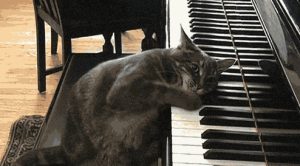
There’s no doubt about it, animals are sensible to music, cats are sensible to music and I have noticed it because I have a cat. Mine gets to hear all kinds of music, and even when he is sleeping on my desk, his head close to the speakers, he doesn’t really care if it’s loud! He can stay very close to the sound source even when the music is blasting through the speakers, his ears moving in all directions. Honestly, I have not noticed a real difference in his reaction according to the type of music, and he has even exposed to the sludgiest metal or the more aggressive hardcore, without leaving the desk.
According to the Huffington post, Dr. Charles Snowdon, a psychologist at the University of Wisconsin-Madison, is trying to create music for cats based on the study of cat calls, which is an octave above human voices. Using sliding notes and high pitches, basing the tempo on purring and suckling sounds (how do you do that?) the good doctor and his team have composed a few tracks
‘We were motivated to make music for cats for two reasons,’ he wrote to The Huffington Post. ‘First, many pet owners told us that they play radio music for their pets while they are at work and we wondered if this had any value. Second, we have developed a theory that suggests that species other than humans can enjoy music but that the music has to be in the frequency range that the species uses to communicate and with tempos that they would normally use.’
They tested the music on 47 cats and made them hear ‘Cozmo’s Air” and ‘Rusty’s Ballad’ as well as two classical pieces, Gabriel Fauré’s “Elegie” and Johann Sebastian Bach’s “Air on a G String,’ and they found that cats ‘were significantly more likely to orient their heads toward it, walk toward it, and even rub up against the speaker’, showing a clear preference…
‘We interpret this as indicating that the cats showed a preference,’ said Snowdon in the email to the Post, and the researchers are even going to publish their research in a serious journal, ‘Applied Animal Behavioral science’
They have uploaded three of their songs on their website Music for Cats, with a description:
‘Kitty Ditties: Playful and quick, these incorporate stylizations of some of the animal calls that are of great interest to cats. A little like sonic catnip, Ditties are meant to arouse interest and curiosity. When ultrasonic playback devices become available (sometime in the near future, we hope) these songs should be even more appealing.
Cat Ballads: Just as the pedal drum provides the hearbeat in human music, the swish, swish of these ballads provides the sound of suckling in feline music. The Cat Ballad should be restful and pleasing for your kitty (perhaps for you too).
Feline Airs: The purr is to cats what the moan is to humans. It can express pleasure or pain, but most importantly, it draws sympathetic emotions from the listener. The timing and cyclic rhythms of purrs are remarkably consistent among all breeds of domestic cats – the Feline Air is based on the pulses of the purr.’
I made my cat listen to two of them and I can’t say it was a big success, he really didn’t care but cats can be moody so I’ll try again…. this Rusty’s ballad was relaxing, but to be honest, he gets much more interested when I watch one of these cat videos on YouTube as long as the cats are meowing, but he is mostly interested by sleeping, cat food, birds and squirrels, may be in this order. Now if scientists could work on a better way to get rid of cat hair, this could be good research.