
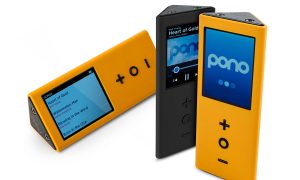
This article on Yahoo by David Pogue basically says that the Pono Player recently launched by Neil Young is not really worth it. I have never tried it so I have basically no opinion about the player that was supposed to revolutionize the way you listen to music, but this in-depth analysis is rather disappointing for Pono music.
The Kickstarter campaign to launch the product raised $6.2 million, way above the expected sum, and the video to promote Pono had many stars (Elvis Costello, Tom petty….and of course Neil Young) who were raving about the product and what a difference Pono was making in their life. I have heard so much about the bad quality of MP3s and how compressed they are, that I sometimes feel guilty to still listen to my iPod, but honestly, would I be able to hear the difference? I am not even a musician, my ears’ sensibility is not that great, I also heard it declines with age, so what’s the point? But Pono promoters kept telling us that we would be able to hear a enormous difference… Still I wasn’t ready to throw away my Apple mini iPod and spend $400 on a Pono player and even more money on these uncompressed large files from Pono Music Force, it is a real investment! For example, if you want to buy the new Sleater-Kinney, it will cost you $8.99 on iTunes but $16.29 on Pono! The new Marilyn Manson is $11.99 on iTunes and $15.29 on Pono….
David Pogue, a former professional musician, is not convinced that it is worth it. When comparing Pono songs with the same one on his iPhone, he says he couldn’t hear any difference. ‘I got worried’, he writes, ‘Is the Pono story a modern-day “Emperor’s New Clothes” fable? Were those famous rock stars just imagining things?’
To find out, he conducted a test using 15 volunteers (17 to 55 year-old people) making them listen to identical songs with identical headphones (first a high-quality one then some cheaper earbuds) using an iPhone and a Pono player. The songs were ‘Saturday in the Park’ by Chicago, ‘Raised on Robbery’ by Joni Mitchell, and ‘There’s a World’ by Neil Young, and connecting the Pono player and the iPhone to a switch, he flipped back and forth between the two at will, without the subjects knowing which player they were listening to. After each listen, the subjects were supposed to pick a sound preference, and the results were highly surprising: ‘Whether wearing earbuds or expensive headphones, my test subjects usually thought that the iPhone playback sounded better than the Pono Player.’
Honestly, I think the difference is not statistically significant, especially with only 15 subjects, but whatever, we are far from the incomparable difference announced by the Pono founders. Pogue emailed to Pono and received this answer:
‘Of approximately 100 top-seed artists who compared Pono to low resolution MP3s, all of them heard and felt the Pono difference, rewarding to the human senses, and is what Pono thinks you deserve to hear.’ But Pogue’s experiment does not confirm this at all… May be these 100 top-seed artists were not doing a blind test?
But there is something I was not aware of, iTunes files come in a 16-bit/256Kbps AAC format (in comparison the Pono format is 24 bit/192kHz) which is nevertheless much better than the compressed MP3 format of the past, so it is not so bad, and honestly, who can tell the difference between both formats? Probably very few people, to nobody because the average human ear can’t perceive the difference, this other article in the Guardian says the same thing, ‘So Pono offers you a feature – for a premium – that you can’t actually perceive’ writes Charles Arthur… Really? This other article in the NY Post and in Gizmodo confirm the same idea coming from any different sound engineers, ‘CD-quality files are more than enough to generate smooth waves for all frequencies detectable by human ears,’ explained Monty Montgomery, executive director of Xiph.org, a nonprofit group for freelance audio and video engineers. ‘The CD-quality standard—which Young and HRA proponents say isn’t sufficient—wasn’t adopted randomly. It’s not a number plucked out of thin air. It’s based on sampling theory and the actual limits of human hearing. To the human ear, audio sampled above 44.1 kHz/16-bit is inaudibly different,’ writes Mario Aguilar in Gizmodo.
To add to the disastrous situation, Pogue says that many songs sold on the Pono Store are actually not high-resolution, so what’s the real deal? Plus brings another good point, whoever is able to hear these subtle differences (or pretend to) what really happens when you are actually listening to your player in the street, or in your car? The background noise will sure mask any of these subtle differences that people pretend to hear. It’s a shame but Pono music does not rise to its high expectations, and this bad publicity is not gonna help.