
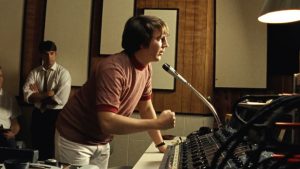
I am late on this, and since everybody has had their say (Ed Huerta reviewed it for us here) I will try to keep this somewhat minimal. “Love And Mercy”, producer Bill Pohlad’s first attempt as a director, is something of a triumph for the son of the late Minnesota Twins owner billionaire financier Carl Pohlad: while there is still something a little felt about the movie, it echoes at least in execution “I’m Not There”, but it still manages to show how inspiration works.
It is the achingly sad story about the great leader of the Beach Boys’ descent into madness as the 23 year old auteur of Pet Sounds (played by Paul Dano) and also the basketcase 40 something Wilson (John Cusack) under the thumb of the sublimely villainous Paul “N…B C” Giamatti as Dr. Landy. It is a redemption story, how family can kill and also cure you, with the result of Wilson’s terrifying and violent father’s reign of terror over the Wilson Brothers as children, leading to a complete breakdown, aided and abetted by LSD and other drugs, till Landy takes over. It appears to be quite true that Wilson was nearly dead when Landy, a psychiatrist who would lose his license over his treatment of Wilson, brought him back, till Landy misdiagnosed and overmedicated Wilson to the point of insanity. Wilson was saved by the cars salesperson Melinda who he fell in love with (a luminous Elizabeth Banks) and built a new family around.
That’s the psychological arc but the selling point is: how does genius work and it sells it well. The question that stands straight here is, there is Brian Wilson, where does it come from? There is the Wilson story of him sitting on the beach without an instrument, or a recorder, and he wrote “Help Me Rhonda” completely, just sitting there on the beach. Hpw can that be filmed? How can you show the mental transaction that leads to music. If you have ever written a song, I’m guessing what you’ve done is what Keith Richards once explained, sat around playing guitar and playing somebody else’s songs and see where it gets you. With Wilson, what he did (does) was play some notes on the piano and in his mind, he could hear all the other parts, he could arrange an orchestra in his brain, and Dano, in a sensitive and moving performance, shows this very well: in the studio, he constructs the song from the pieces he has imagined.
There is very little I don’t admire about “Love And Mercy” but this is why I love it, this insistence upon the sound in the head becoming real through work. It feels like the truth, it feels like how creation should occur.
Grade: A